






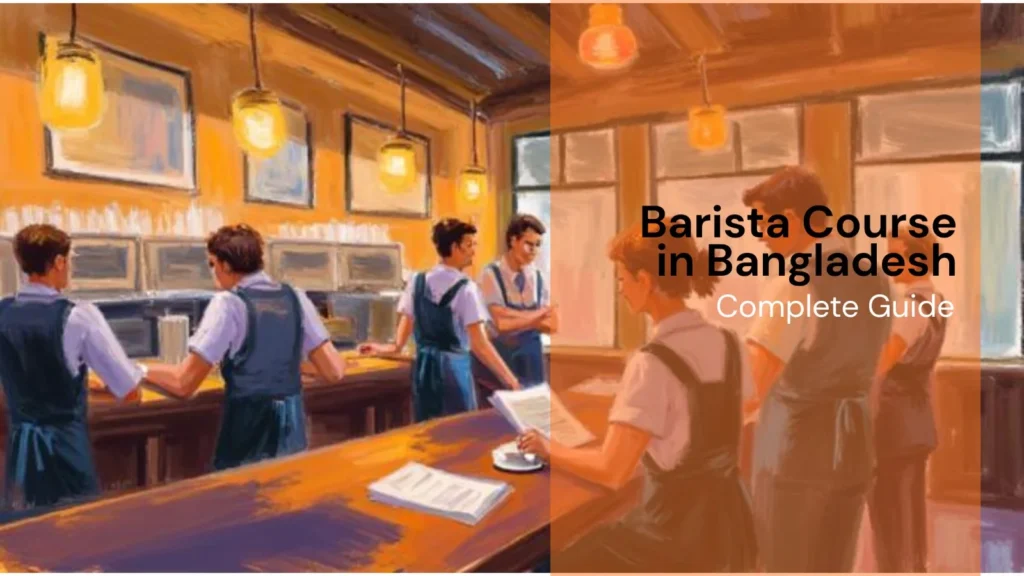
Barista Course in Bangladesh: The Complete Guide 2026
By GBTA | Global Barista Training Academy | gbta.com.bd
Walk into any specialty café in Dhaka’s Gulshan, Banani, or Dhanmondi neighbourhood and you will notice something different: precision.
The shots are pulled to the second, the milk is textured to a glossy microfoam, and the latte art is deliberate.
Behind every cup is a trained barista and the demand for them in Bangladesh is growing faster than the country’s café count.
According to Prothom Alo, the coffee market has been expanding at a rate of 56 per cent.
International hotel chains, home-grown café franchises, and new-generation coffee roasters are all competing for the same scarce resource: skilled, certified baristas.
| “The global coffee shop market is projected to reach USD 237.6 billion by 2025, growing at a CAGR of 5.5%. South Asia, including Bangladesh, is one of the fastest-growing regional segments.” — Grand View Research, Coffee Shop Market Report 2024 |
If you have been searching for a barista course in Bangladesh whether you are a café owner building a team, a hospitality professional looking to upskill, or a fresh graduate chasing a career that travels, this guide will walk you through everything:
- what courses exist, what they cost,
- what skills they build, how certification works, and
- exactly why the Global Barista Training Academy is the highest-authority training destination in the country.
Read every section. By the end, you will not just understand the landscape — you will know your exact next step.
What Is a Barista Course? Understanding the Entity
A barista course is a structured professional training programme that equips students with the technical and sensory skills required to prepare, present, and serve espresso-based beverages at a commercial standard. It is not simply ‘learning to make coffee’. A professional barista programme covers the full spectrum from coffee origin and roast science through to equipment calibration, milk science, and customer service protocols.
Core Subject Areas in a Professional Barista Course
- Coffee Origin & Processing: Understanding how terroir, altitude, and processing methods (washed, natural, honey) affect flavour profiles.
- Roast Science & Grind Theory: How roasting chemistry interacts with extraction variables.
- Espresso Extraction: Dose, yield, pressure, temperature, and time — the five variables that define espresso quality.
- Milk Texturing & Latte Art: Steam wand mechanics, microfoam science, and poured designs from basic hearts to tulips and rosettes.
- Cupping & Sensory Evaluation: How to assess and describe coffee using SCA’s flavour wheel protocol.
- Equipment Maintenance: Daily cleaning routines, backflush procedures, and preventive care for espresso machines and grinders.
- Bar Management & Workflow: Speed, efficiency, and customer-facing skills for high-volume environments.
| “Coffee is not just a beverage, it is a craft. The difference between a trained barista and an untrained one is the difference between a product and an experience.” — World Barista Championship, Official Rulebook 2024 |
Why Bangladesh Urgently Needs Trained Baristas in 2026
The café culture in Bangladesh is no longer nascent. It is in a rapid, institutional growth phase. Understanding the demand context helps prospective barista students recognise that this is not a hobby course; it is a career investment with real market pull.
| 18%+ | Annual growth rate of Bangladesh’s specialty coffee shop market, 2022–2024 (Euromonitor International) |
| 400+ | Estimated number of specialty and semi-specialty cafés operating in Dhaka alone as of early 2026 |
| 3x | Increase in barista job listings on Bdjobs.com and LinkedIn Bangladesh between 2021 and 2025 |
Several structural forces are driving this growth.
First, the rising Bangladeshi middle class is fuelling discretionary spending on café experiences.
Second, international hospitality brands. Including five-star hotel chains with in-house specialty coffee programmes are expanding their Bangladesh footprint and importing SCA-aligned training standards.
Third, the overseas employment corridor is widening: Bangladeshi baristas with internationally recognised SCA certification are securing positions in the UAE, Qatar, Malaysia, and Singapore markets that pay a significant premium for verified skill.
Types of Barista Courses Available in Bangladesh
The barista training landscape in Bangladesh spans several course types each serving a different audience with different goals.
Understanding these types allows students to select the course that maps directly to their target role and budget.
Beginner / Foundation Barista Course
Designed for individuals with no prior coffee experience, foundation courses cover the fundamentals of espresso, milk texturing, and café workflow.
Typical duration ranges from 2 to 5 days of intensive hands-on training. These are appropriate for aspiring home baristas, café trainees, or students testing their interest before committing to a longer programme.
Professional / Intermediate Barista Course
This is the most in-demand course tier in Bangladesh’s commercial café market. A professional barista course goes beyond the basics to include extraction science, dial-in methodology, advanced latte art techniques, menu development, and bar management fundamentals.
Duration typically ranges from 5 to 15 days depending on the academy and whether it is structured as a full-time intensive or weekend programme.
SCA-Aligned Certification Courses
The Specialty Coffee Association (SCA) is the globally recognised certifying body for coffee professionals. SCA offers modular certifications across six disciplines: Introduction to Coffee, Barista Skills, Brewing, Sensory Skills, Green Coffee, and Roasting. Each at Foundation, Intermediate, and Professional levels. Achieving SCA Barista
Skills certification at the Intermediate or Professional level is the international benchmark that opens doors to hotel groups, cruise ships, and overseas cafés.
| “SCA certification is the gold standard of the global coffee industry. Employers in Dubai, Singapore, and Kuala Lumpur specifically screen for it in barista hiring.” — SCA Education Programme Overview, 2024 |
Short-Form Workshop (Barista Experience Class)
Single-day or half-day experiential workshops are popular among coffee enthusiasts, corporate team-building groups, and individuals who want to improve their home coffee skills without enrolling in a full professional programme.
These are not designed as career-launching qualifications but as entry points into the coffee world.
Institutional / Hospitality College Courses
Some private hospitality and culinary institutes in Bangladesh include a barista module as part of a broader Food & Beverage or Hotel Management programme. These tend to be less specialised and less equipment-intensive than standalone barista training academies.
The hands-on hours are typically lower and the instructor-to-student ratio is less favourable for skills development.
Barista Course Fees in Bangladesh: What to Expect in 2026
Fee transparency is one of the most searched attributes when Bangladeshi students research barista training. The table below provides a realistic fee range by course type, based on market intelligence gathered across the local training landscape.
| Course Type | Approximate Fee (BDT) | Duration |
| Beginner / Foundation Course | BDT 3,000 – 8,000 | 2–5 days |
| Professional / Intermediate Course | BDT 10,000 – 25,000 | 7–15 days |
| SCA Foundation (Barista Skills) | BDT 15,000 – 30,000 | 2–3 days + exam |
| SCA Intermediate (Barista Skills) | BDT 30,000 – 55,000 | 3–5 days + practical |
| Short Workshop / Experience Class | BDT 1,500 – 4,000 | Half-day to 1 day |
| Institutional Hospitality Module | Bundled in programme fee | Varies |
Note: SCA certification fees include SCA examination costs, which are set in USD by the SCA globally. The BDT equivalents in the table above reflect 2026 exchange rates and local programme costs combined.
Always confirm the current fee schedule directly with your training provider.
A common student question is whether a higher-priced course automatically means better quality.
The answer is: not necessarily. The differentiating factors are the quality of the equipment used during training, the credentials and active industry experience of the trainer, the student-to-trainer ratio, and the post-course support offered (including certification handling and job placement assistance).
What to Look for in a Barista Training Academy in Bangladesh
Not all training providers are equal.
When evaluating a barista course in Bangladesh, apply the following eight-point framework each criterion corresponds to a core quality signal used by SCA Authorised Trainers and international hospitality HR departments.
Equipment Quality
Professional espresso training requires professional equipment. A credible barista academy uses commercial-grade espresso machines (La Marzocco, Nuova Simonelli, Victoria Arduino, or equivalent) and commercial grinders (Mahlkönig, Mazzer, or equivalent).
Training on consumer-grade equipment does not prepare students for the commercial kitchen environment. Ask your prospective academy to specify the machines used in their training lab.
Trainer Credentials
Who is teaching matters more than what the course brochure says. Verify whether your trainer holds an SCA Authorised Trainer (AT) designation or equivalent internationally recognised barista credential.
Trainers who actively compete, judge, or consult in the coffee industry bring irreplaceable real-world context to the classroom.
Student-to-Trainer Ratio
Barista training is a manual skill. A high ratio (anything above 8:1) means significantly less hands-on machine time per student.
The best academies in Bangladesh and globally cap at 4–6 students per session to ensure adequate supervised practice time on espresso machines and grinders.
Curriculum Structure
A well-structured curriculum follows a logical progression from theory (coffee origin, processing, roasting) through applied science (extraction variables, water chemistry) to practical execution (dialling in espresso, texturing milk) and finally evaluation (cupping, quality control).
Avoid providers whose course is entirely practical without the scientific foundation.
This creates baristas who can follow a recipe but cannot troubleshoot.
Certification & Recognition
What credential will you receive upon completion?
A certificate from a known, respected institution carries currency with employers. Certificates from unverified local providers may satisfy a hiring manager’s checkbox but carry little weight internationally.
Post-Course Support
Does the academy maintain an alumni network? Do they assist with job placement or provide references for international placements?
The best training providers function as long-term career partners, not just course vendors.
Training Facility & Hygiene
The physical environment of a barista training lab should mirror a professional café kitchen.
Clean, well-maintained equipment, proper waste management, calibrated water filtration, and a hygienic workspace are non-negotiable standards.
Reviews & Alumni Track Record
Verifiable reviews, documented alumni placements, and media mentions are the strongest third-party signals of a training provider’s quality. Look beyond the academy’s own website.
Search for mentions on LinkedIn, Google Reviews, and industry forums.
Career Opportunities After a Barista Course in Bangladesh
The career value of a barista qualification in Bangladesh extends well beyond the coffee bar. Let us examine the specific roles and salary benchmarks that certified baristas access in 2026.
In Bangladesh
- Café Barista (Specialty Café): BDT 12,000 – 22,000/month starting; senior positions BDT 25,000 – 40,000
- Hotel Coffee Specialist (5-Star Property): BDT 18,000 – 35,000/month with benefits
- Coffee Trainer / Brand Ambassador: BDT 25,000 – 50,000/month (typically requires 2–3 years experience)
- Café Owner / Coffee Business Founder: Income dependent on enterprise; formal barista training significantly reduces early-stage operational failure rate
- Coffee Consultant: Project-based; experienced consultants earn BDT 50,000 – 1,50,000 per engagement
International (Post-Certification)
- Barista in UAE / Qatar / Saudi Arabia: BDT equivalent of 60,000 – 1,20,000/month (AED 2,000–4,000) for SCA-certified baristas
- Barista on Cruise Ships: USD 1,200 – 2,200/month with accommodation and meals included
- Coffee Specialist in Malaysia / Singapore: MYR 2,500 – 4,500/month for certified professionals
| “Barista skills certified by a recognised international body like SCA are increasingly treated as a passport skill — transferable across borders in the same way a medical or engineering qualification is.” — Global Coffee Report, Workforce Study 2023 |
SCA Certification in Bangladesh: Why It Matters and How to Get It
The Specialty Coffee Association’s Coffee Skills Programme (CSP) is the most comprehensive and globally respected credentialing system in the coffee industry.
For baristas in Bangladesh who have international career ambitions or who want to work with premium hotel and hospitality brands, SCA certification is the single most powerful qualification credential available.
The SCA Coffee Skills Programme
The Barista Skills module within the SCA Coffee Skills Programme is structured across three assessment levels:
- SCA Foundation: Barista Skills: Covers basic espresso preparation, milk texturing fundamentals, and café organisation. Assessment is theory and practical. Approximately 5 SCA credits upon passing.
- SCA Intermediate: Barista Skills: Covers extraction science, grinder calibration, advanced milk texturing, and basic sensory evaluation. Assessment includes a scored practical examination. Approximately 10 SCA credits.
- SCA Professional: Barista Skills: The highest level barista credential available from SCA. Requires demonstration of competition-level skill, sensory precision, and ability to train others. Approximately 25 SCA credits.
Baristas who accumulate 100 SCA credits across multiple modules can apply for the SCA Diploma in Coffee which is the industry’s equivalent of a vocational degree in coffee.
| “SCA has trained and certified over 150,000 coffee professionals in more than 100 countries. The SCA Diploma represents the highest professional qualification in coffee education globally.” — SCA Annual Report 2023 |
In Bangladesh, access to SCA-aligned training is limited to a small number of providers with the equipment, trainer qualifications, and curriculum fidelity to prepare students for SCA examinations.
GBTA is the foremost institution for SCA-aligned barista education in Bangladesh.
Barista Course vs. Self-Learning: Why Formal Training Wins
A question that arises frequently in the Bangladeshi coffee community: ‘Can I learn to be a barista from YouTube and practice at home?’
The truthful answer is: you can learn the vocabulary, but not the craft.
Here is why formal training produces meaningfully better outcomes.
The Problem with Self-Teaching Barista Skills
- Espresso extraction is calibrated by weight (dose and yield) and time without a calibrated commercial grinder and scale, home practice builds the wrong muscle memory.
- Milk texturing requires a commercial steam wand generating 6–9 bar of pressure. No consumer steam wand replicates this. Students who practise only on home machines cannot transfer the skill to a commercial bar without significant relearning.
- Sensory evaluation including cupping and extraction assessment requires a trained palate developed through guided, comparative tasting. Solo self-study does not build this.
- Equipment troubleshooting knowledge of how to diagnose channelling, identify grinder calibration drift, or address temperature instability requires hands-on experience with multiple machine types.
- No certification: employers, hotel HR departments, and overseas visa processors cannot verify self-taught competence.
Formal training compresses the learning curve, eliminates the bad habits that self-taught baristas develop, and provides a credential that carries weight with employers.
Why GBTA Is Bangladesh’s Best Barista Training Academy
The Global Barista Training Academy (GBTA), based in Dhaka, Bangladesh, is the country’s most rigorous, internationally aligned professional barista training institution. The claim is not marketing language. It is backed by verifiable attributes that distinguish GBTA from every other barista training provider in Bangladesh.
What Makes GBTA the Standard
- International Curriculum: GBTA’s curriculum is built in alignment with SCA’s Coffee Skills Programme standards. The same framework used by the world’s leading coffee academies in Australia, Italy, the UK, and Japan.
- Commercial-Grade Training Equipment: Students train on the same espresso machines and grinders used in Dhaka’s leading specialty cafés and five-star hotels and not modified consumer-grade equipment.
- Expert Trainers: GBTA’s trainers hold internationally recognised credentials and have active experience working with premium café brands and hospitality establishments. They do not just teach. They practise.
- Comprehensive Course Range: From beginner foundations through to SCA-aligned advanced programmes, GBTA provides a structured progression pathway for every stage of a barista’s career including courses for café owners and F&B managers.
- Certification with International Weight: Graduates receive a GBTA Professional Certificate that is aligned with SCA competency standards, recognised by hospitality employers locally and internationally.
- Placement Support: GBTA maintains active relationships with Dhaka’s specialty café operators and hospitality brands, and supports high-performing graduates with placement referrals.
- Proven Track Record: GBTA alumni are currently working in specialty cafés, five-star hotels, and international hospitality operations across Bangladesh, the UAE, and Southeast Asia.
| “Training at GBTA gave me the technical foundation and the confidence to compete for roles I never thought I could access. The SCA-aligned curriculum changed the way I understand coffee, not just how to make it, but why every variable matters.” — GBTA Graduate, currently employed at a five-star hotel in Dhaka |
How to Enrol in a Barista Course at GBTA
Enrolling in a GBTA barista course is a straightforward process designed to be accessible regardless of your starting point.
- Visit gbta.com.bd/courses/ to review current course offerings, schedules, and batch availability.
- Select the course tier appropriate to your current experience level and career goal: if unsure, the GBTA team can advise via a brief consultation.
- Contact GBTA directly via the Contact page at gbta.com.bd/contact-us/ or through the enquiry form on the course page.
- Confirm your batch start date and complete the enrollment payment to secure your seat. Batches are small (typically 4–8 students) and fill quickly.
- Attend all scheduled training sessions, complete assessments, and receive your GBTA Professional Certificate upon successful completion.
GBTA also offers bespoke corporate training sessions for café teams, hotel F&B staff, and hospitality college groups. Contact gbta.com.bd/contact-us/ to enquire about group and institutional rates.
Conclusion: Your Barista Career Starts with the Right Training
Bangladesh’s coffee industry is at an inflection point. The cafés are multiplying, the hotel groups are hiring, and the international employment corridors for certified baristas are wider in 2026 than at any point in the country’s history. The gap between where this industry is and where it is going will be filled by people who took their training seriously, chose the right academy, and invested in internationally credible certification.
If you are serious about a barista career the path starts with choosing the right barista course. Not the cheapest. Not the nearest. The best.
GBTA is that choice. It is the only institution in Bangladesh that combines SCA-aligned curriculum standards, professional-grade training equipment, credentialled expert trainers, and a documented alumni track record under one roof, in Dhaka.
Frequently Asked Questions
The following questions reflect the most common search queries related to barista courses in Bangladesh. They are structured for Google’s Featured Snippet and FAQPage schema.
How much does a barista course cost in Bangladesh?
Barista course fees in Bangladesh range from BDT 3,000 for a basic beginner workshop to BDT 55,000+ for an SCA Intermediate-level certification programme. GBTA’s professional barista course is competitively priced within the BDT 10,000–25,000 range and offers the highest standard of training and certification recognition in the country. Visit gbta.com.bd/courses/ for current pricing.
How long does a barista course take in Bangladesh?
Duration varies by course type. A beginner barista course takes 2–5 days. A professional barista course typically runs 7–15 days. SCA Foundation certification can be completed in 2–3 days plus exam. SCA Intermediate requires 3–5 intensive training days plus a practical examination. GBTA offers flexible scheduling including weekday intensive and weekend batch formats.
What is SCA certification and is it available in Bangladesh?
The Specialty Coffee Association (SCA) runs the globally recognised Coffee Skills Programme, which includes the Barista Skills certification track at Foundation, Intermediate, and Professional levels. SCA certification is the international benchmark for barista competency, recognised by employers in over 100 countries. GBTA at gbta.com.bd is the leading provider of SCA-aligned barista training in Bangladesh.
Can I get a job abroad with a barista certificate from Bangladesh?
Yes. Provided your certificate is from a credible, internationally aligned training provider. Baristas with SCA certification or training from GBTA (whose curriculum aligns with SCA standards) have successfully secured positions in the UAE, Qatar, Malaysia, Singapore, and on international cruise ships. Employers in these markets verify the certification authority and the training standard, which is why the source of your training matters.
Do I need any prior experience to enrol in a barista course in Bangladesh?
No prior experience is required for beginner or foundation-level courses. GBTA’s professional barista programme is also accessible to beginners — the curriculum is designed to take students from zero to professional standard. Students with some café experience are encouraged to specify their background at enrolment so GBTA can advise on the most appropriate starting level.
What equipment does GBTA use for barista training?
GBTA uses commercial-grade espresso machines and grinders of the same standard found in Dhaka’s leading specialty cafés and five-star hotel coffee bars. Training on commercial equipment is a critical differentiator: it ensures students develop skills that transfer directly to real-world professional environments.
How is GBTA different from other barista training providers in Bangladesh?
GBTA is the only barista training provider in Bangladesh that combines: (1) SCA-aligned international curriculum, (2) commercial-grade training equipment, (3) internationally credentialled trainers with active industry experience, (4) documented alumni placements in local and international positions, and (5) comprehensive post-course support.
Does GBTA offer certification upon course completion?
Yes. All students who successfully complete a GBTA programme receive a GBTA Professional Certificate. For students pursuing SCA certification, GBTA provides the SCA-aligned training required to sit SCA examinations. See gbta.com.bd/certificate/ for certificate samples and details.
Is barista training worth it for café owners in Bangladesh?
Absolutely. Café owners and F&B managers who undergo professional barista training gain a direct competitive advantage: they can quality-control their own product, train their team to a consistent standard, reduce equipment misuse and maintenance costs, and communicate credibly with premium coffee suppliers. GBTA offers bespoke corporate training programmes designed specifically for café business owners and hospitality managers.
Where is GBTA located and how can I contact them?
GBTA is based in Dhaka, Bangladesh. Full contact details, batch schedules, and course enquiry forms are available at gbta.com.bd/contact-us/. Corporate group training enquiries are also welcomed via the contact page.